
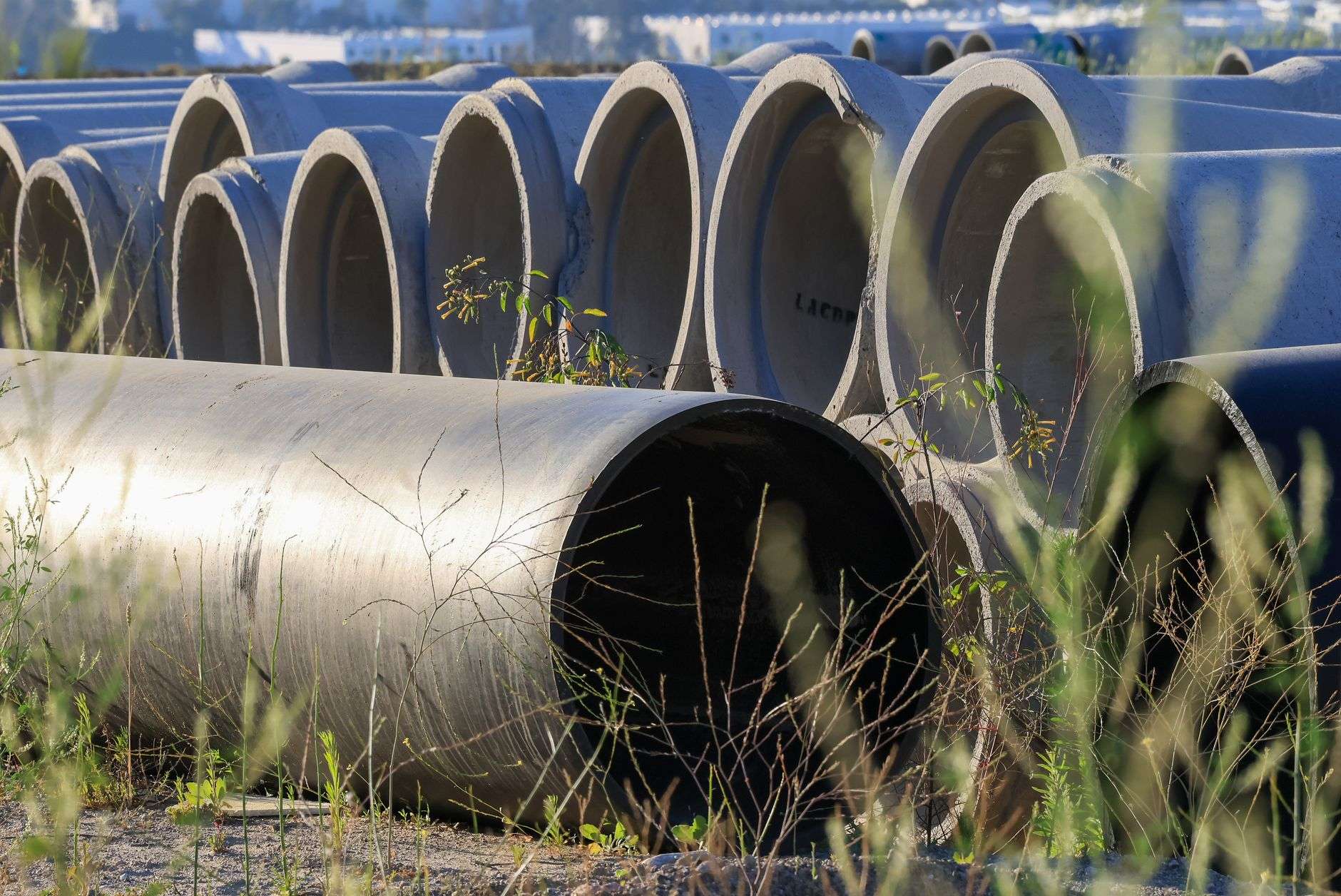
A 600mm concrete pipe is the default culvert on access roads and site entrances across the region, largely because it is what the yard has in stock. In a normal month it works. In the storms that arrive in the long rains it overtops, the road washes out, and the repair costs several times what the larger pipe would have.
What actually determines the size
Three inputs, and none of them is what the neighbour used:
- Catchment area. How much ground drains to this point. On a sloping site this includes land well outside the plot boundary, which is the input most often underestimated.
- Rainfall intensity. Kampala and much of central Uganda see short, very intense bursts — the peak flow that matters is generated in well under an hour, not over a day. Sizing on average monthly rainfall gives an answer that is far too small.
- Runoff coefficient. How much of that rain runs off rather than soaking in. Bare compacted murram, a paved yard and a roofed area all shed the great majority of what lands on them. Development increases runoff dramatically, which is why a culvert that coped before the estate was built stops coping after.
Multiply those through and you get a design flow. The pipe is then sized to carry it at part-full flow — we design to about 75% depth, not full bore, so that debris and a margin of underestimate do not immediately cause surcharge.
Why the pipe is not the whole answer
Most culvert failures we inspect are not the pipe being too small in isolation. They are:
- Blockage. Silt, sand, and vegetation reduce an already tight pipe to a fraction of its capacity. A 900mm pipe half silted still carries more than a clean 600mm.
- No headwall. Without headwalls and wingwalls, the embankment around the inlet erodes, the fill washes into the pipe, and the road edge collapses.
- Wrong invert level. A pipe laid above the natural channel bed ponds water on the upstream side until it finds a way around, usually through the road.
- No outlet protection. Water exits at speed and scours a hole that works its way back until it undermines the pipe itself. Stone pitching or a concrete apron at the outlet prevents this cheaply.
What we specify as a minimum
On site access crossings we do not go below 900mm diameter regardless of the calculation, for the practical reason that anything smaller cannot be cleaned by hand and will silt up permanently. Where the calculated flow needs more, we use twin pipes or a box culvert rather than a single very large pipe that is hard to bed properly.
Every crossing gets headwalls at both ends, an apron at the outlet, and a minimum longitudinal gradient of about 1 in 100 so it is self-cleansing.
Bedding matters as much as size
Precast pipes crack when they are laid straight onto uneven excavated ground and loaded by a lorry. We bed on compacted granular material shaped to support the lower third of the pipe, joint properly, and backfill in compacted layers on both sides simultaneously so the pipe is not pushed sideways.
The economics
Going from 600mm to 900mm on a site entrance is a modest increase on the material and the same excavation crew. Rebuilding a washed-out access road, in the wet, while a project is running, is not modest at all — and the site is unreachable while it happens.
OK Estate Construction and Supply Limited designs and builds site drainage and access works across Uganda and South Sudan. Talk to our team.