
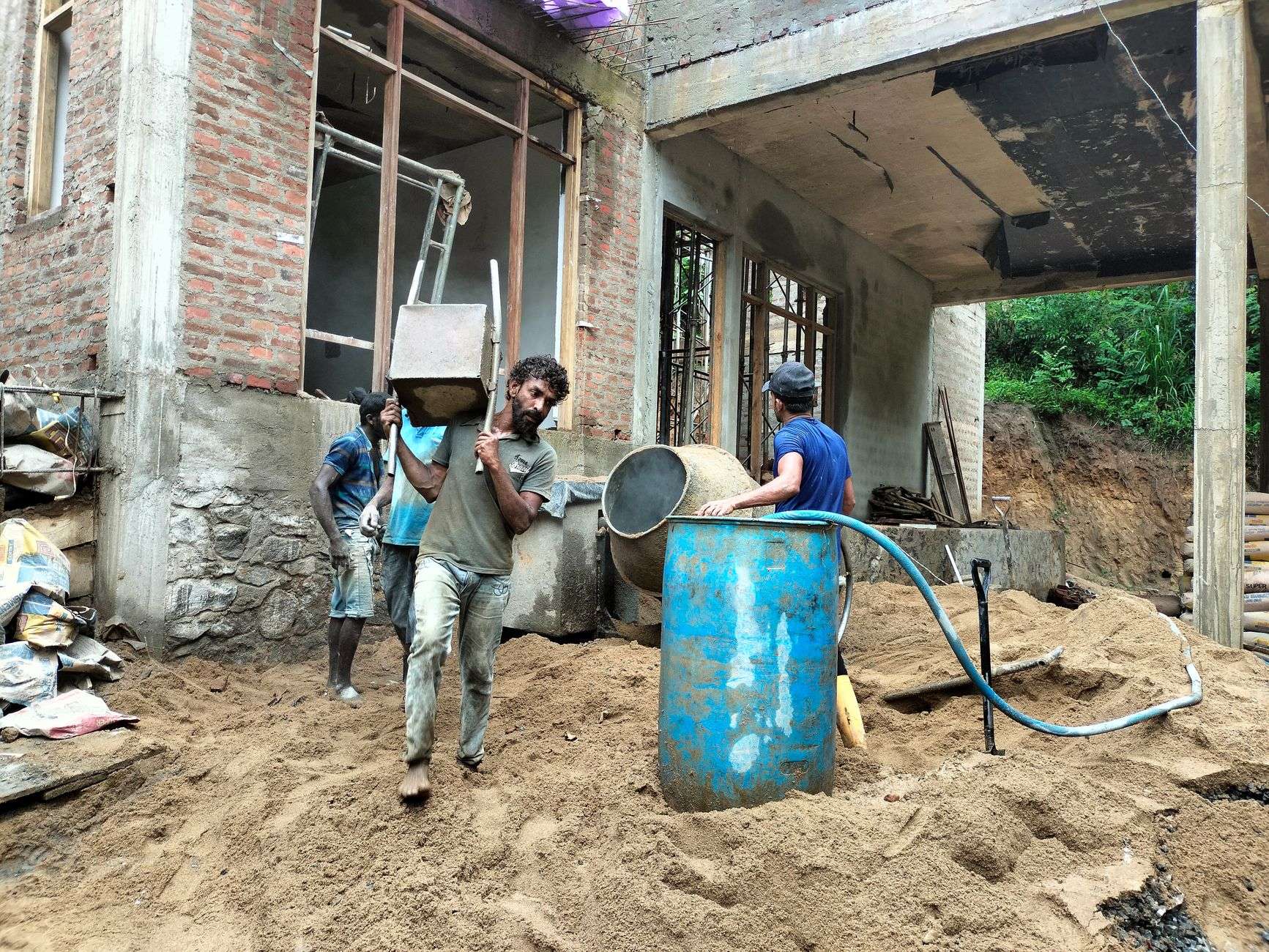
Almost every small and medium site in the region batches concrete by volume — a headpan or a gauge box of cement, two of sand, four of aggregate. It is workable, it is what the labour understands, and for a lot of work it is entirely appropriate. But it only produces the strength on the drawing if a few things are controlled, and on most sites they are not.
What goes wrong with volume batching
Bulking of sand. Damp sand occupies noticeably more volume than dry sand — commonly 20–30% more at the moisture contents you get from a heap that has been rained on. Measure damp sand by volume and you are putting substantially less actual sand into the mix than you think, which changes the aggregate-to-cement ratio and the water demand at the same time.
The shovel. Where there is no gauge box, proportions are measured in shovelfuls. Nobody loads a shovel of cement the same way they load a shovel of aggregate, and nobody does either consistently for eight hours.
Water. This is the big one. Water is added by eye until the mix “looks right” to whoever is at the mixer, and a wetter mix is easier to place, so it drifts wetter through the day. Excess water is the fastest way to lose strength there is — a mix with a water-cement ratio of 0.7 instead of 0.5 loses a very large share of its design strength, and it shrinks more, and it is more permeable.
What we do about it
We do not pretend every site can afford a weigh-batching plant. What we insist on is a set of controls that make volume batching reliable:
- Gauge boxes, not shovels. Timber boxes sized so that one box of cement equals one 50kg bag, with the aggregate boxes sized to the mix. They cost a morning of a carpenter’s time.
- A water measure. A marked drum or graduated bucket, and a fixed quantity per batch adjusted only by the person supervising, not by the mixer operator.
- A bulking test on the sand. Simple field test, takes fifteen minutes, repeated whenever the sand source or the weather changes. The result adjusts the sand box.
- A slump test at the start and middle of each pour. It is the only quick, honest check that the water is under control, and it is cheap.
- Cubes. Cast, cured properly and crushed at 7 and 28 days. Without cubes there is no evidence of anything.
When we move to ready-mix
For anything structurally demanding — a large suspended slab, high-grade columns in a multi-storey frame, work where the pour must be continuous — we price ready-mix. You get weigh-batched proportions, controlled water, admixtures where useful, and delivery tickets that state exactly what was in the truck.
Ready-mix has its own site discipline: check the ticket against the order before discharge, check the time since batching, and never let anyone add water at the chute to make it easier to place. That last one undoes the entire benefit and it happens on plenty of sites.
The economics
Concrete is one of the cheaper materials in a building and one of the most consequential. Getting a mix from an actual 20 N/mm² to an actual 25 N/mm² costs a modest amount of extra cement. Discovering after 28 days that cubes came back at 14 N/mm² costs demolition, or a strengthening scheme, or a building that quietly has less capacity than its drawings claim.
The gauge boxes are the cheapest insurance on the site.
OK Estate Construction and Supply Limited manages concrete works and quality control across Uganda and South Sudan. Talk to our team.