
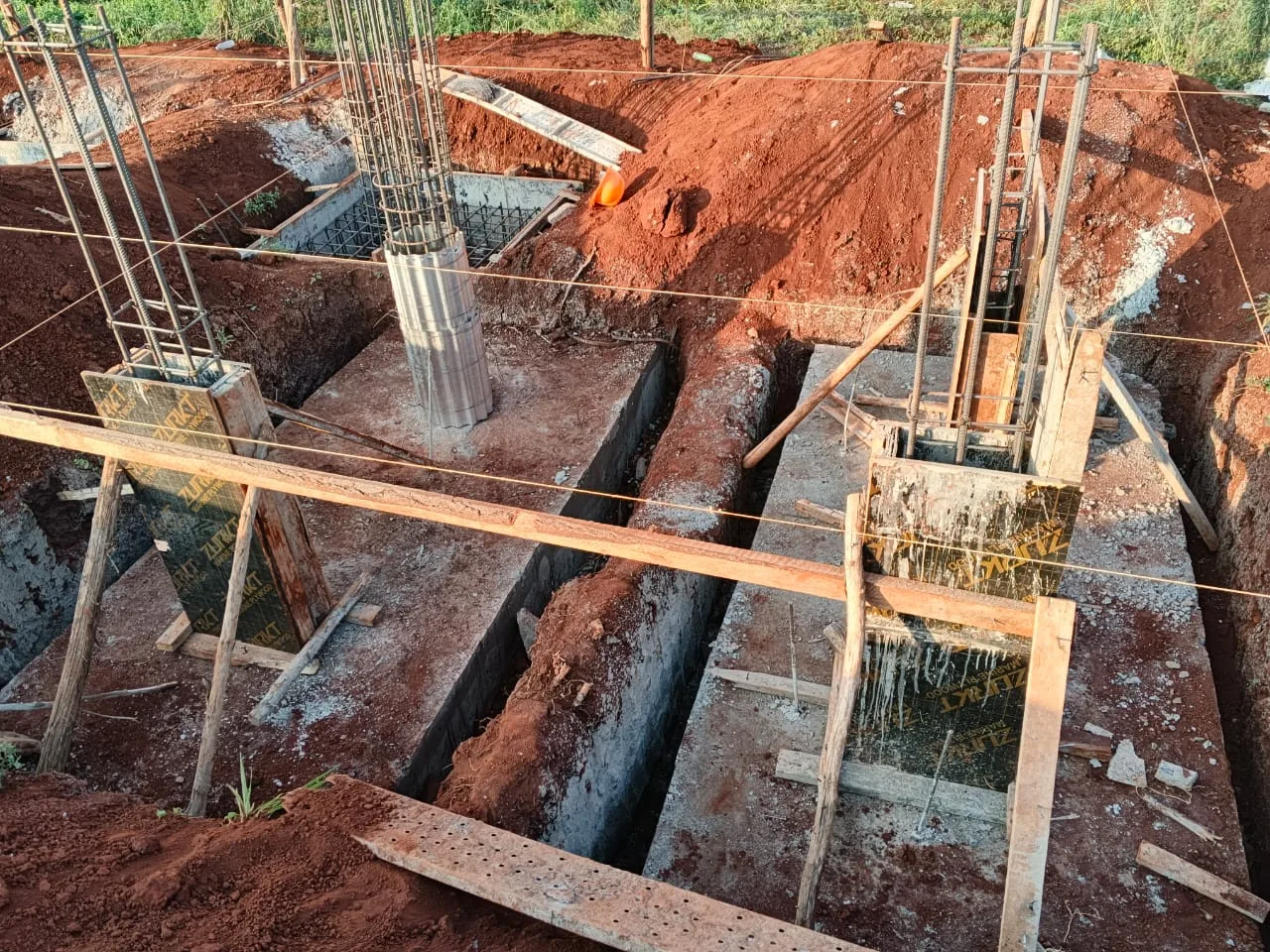
Foundation failures are rarely dramatic. They are slow, and they almost always trace back to one of three details that cost very little to get right and are skipped whenever a site is running behind.
Blinding
Blinding is the thin layer of lean concrete — usually 50–75mm at a weak mix — poured over the bottom of an excavation before any reinforcement goes in. It is not structural, and that is exactly why it gets left out.
What it does: it gives you a clean, level, dry platform to set steel on. Without it, the bottom bars sit in mud. The cover blocks sink. Soil gets pushed up into the concrete during the pour, and the bottom face of the footing — the face in permanent contact with damp ground — ends up as a weak, porous mix of concrete and clay. That is the face you most need to be dense.
It also stops the excavation base from being churned up by the steel-fixing gang walking on it, and it lets you mark out the pad and the starter bar positions accurately with a chalk line instead of guessing over uneven soil.
Cover
Cover is the distance from the outside face of the concrete to the nearest steel. For foundation concrete cast against ground we work to 75mm, and 50mm where blinding has been laid. The number is not arbitrary: it is the thickness of alkaline concrete that keeps moisture and chlorides away from the reinforcement.
Steel with insufficient cover corrodes. Rust occupies several times the volume of the steel it came from, and it splits the concrete off from the inside. Once a footing is spalling, the crack lets in more water and the process accelerates.
Getting cover right needs three things on site: purpose-made concrete cover blocks, not stones or timber offcuts; enough of them, at roughly 800mm spacing in both directions; and someone checking after the steel gang has finished walking on the cage, because blocks get dislodged.
Curing
Concrete does not dry — it hydrates, and hydration needs water. In Kampala or Juba sun, an uncovered pour loses surface moisture within hours. What you get is a footing whose outer 20mm never reached its design strength and is far more permeable than the core.
Our rule is simple: every pour is covered as soon as it can take the covering without marking, and kept damp for a minimum of seven days. Hessian and polythene, wetted morning and afternoon. Ponding where the geometry allows. On slabs we use a curing membrane if water supply on site is unreliable.
Seven days of a labourer with a hosepipe is one of the highest-return activities on any site, and it is the first thing dropped when the programme slips.
How to check without being an engineer
You do not need training to ask three questions on a site visit:
- Is there a grey layer of lean concrete under the reinforcement, or is the steel sitting on soil?
- Are there proper cover blocks holding the cage off the blinding and away from the formwork faces?
- Was yesterday’s pour covered and wet this morning?
If the answer to all three is yes, a great deal is already going right.
OK Estate Construction and Supply Limited builds substructure works across Uganda and South Sudan. Talk to our team about supervision on your project.