
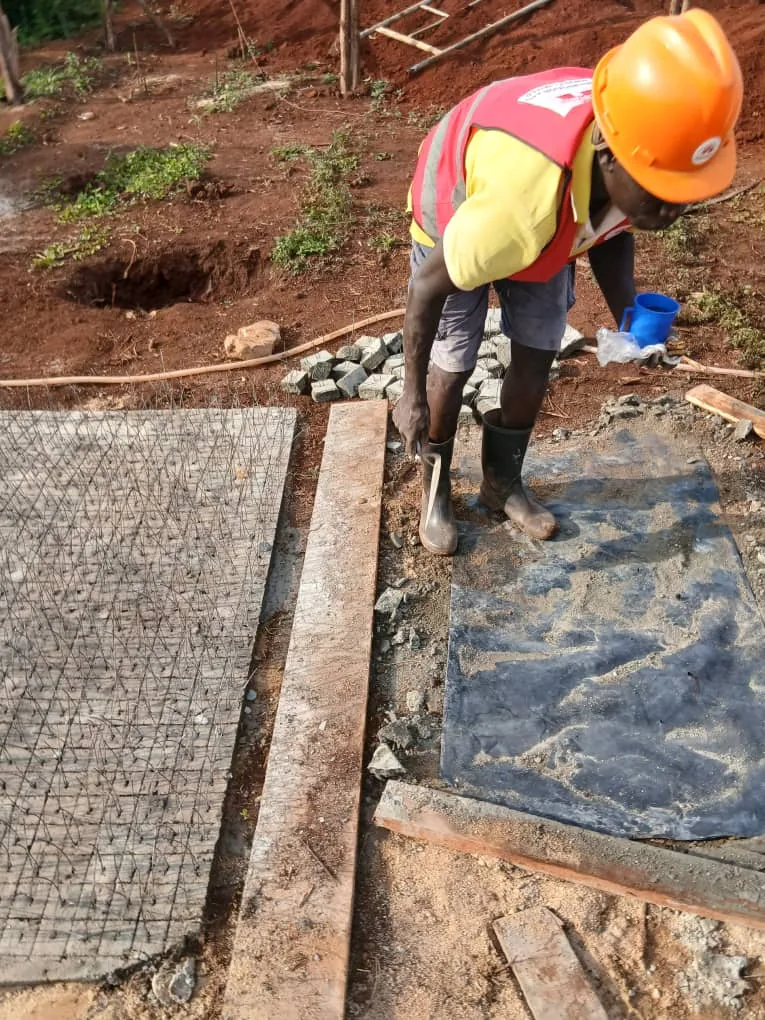
Clients call us about slab cracks more than any other defect. In the great majority of cases the slab is carrying its load perfectly well — the crack is a shrinkage crack, and it appeared because of how the slab was detailed, poured and cured rather than because it is overloaded.
Why slabs crack when they are not overloaded
Concrete shrinks as it hydrates and dries. If it were free to shrink, nothing would crack. But a slab is restrained — by the beams and columns it is cast into, by the friction of the ground beneath a ground-bearing slab, by the reinforcement itself. Restraint plus shrinkage equals tension, and concrete has very little tensile strength.
So the concrete cracks. The job of the reinforcement, at this stage, is not to stop cracking — it cannot — but to make sure the cracking happens as many fine cracks rather than a few wide ones. Fine cracks are cosmetic. Wide cracks let water to the steel.
Mesh versus loose bar
Fabric mesh is faster to lay, gives consistent spacing, and is generally what we use for ground-bearing slabs and lightly loaded suspended slabs. Its weaknesses on site are practical ones: it gets walked flat, and laps are frequently too short. Mesh needs a full one-mesh overlap at joints — not the 100mm we often see — and it needs enough chairs to hold it at the right level while a gang walks on it.
Loose bar gives more control where the design needs different steel in different directions or a concentration over a support. It takes longer to fix and depends more on the skill of the gang, but it is the right answer for two-way suspended slabs.
The top steel people leave out
Over continuous supports — a slab spanning across a beam and continuing to the next bay — the slab bends the opposite way, so it needs steel in the top face. This is the single most commonly omitted reinforcement in slabs we inspect. It is invisible once cast, the slab does not collapse without it, and it produces a straight crack running along the line of the beam within a year or two.
If your slab has a neat straight crack directly over a beam, that is very likely the reason.
Spacing and the maximum you should accept
Wide bar spacing means the concrete between bars has nothing controlling it, and cracks there get wide. As a working rule we do not let main bar spacing exceed three times the slab thickness, and we bring it much closer than that where the slab is exposed or where the finish is decorative. Distribution steel in the secondary direction is not optional filler — it spreads local loads and controls shrinkage across the span.
Pouring and curing
Three habits prevent most of the rest:
- Pour a bay in one continuous operation. A cold joint in the middle of a bay because the mixer ran out is a crack waiting to open.
- Compact properly with a poker, not by tamping alone. Voids under bars are both a strength and a durability problem.
- Cure for seven days minimum. Most shrinkage cracking is decided in the first week. Covered and kept wet, a slab shrinks slowly and cracks finely. Left in the sun on day one, it does the opposite.
When a crack is worth worrying about
Get an engineer to look if a crack is wider than about 0.3mm, if it runs diagonally from a column, if it is accompanied by visible deflection, or if it is growing month on month. Otherwise, a fine map of hairline cracks in a ground-bearing slab is normal concrete behaviour and does not mean the building is failing.
OK Estate Construction and Supply Limited carries out slab and frame construction across Uganda and South Sudan. Talk to our team.