
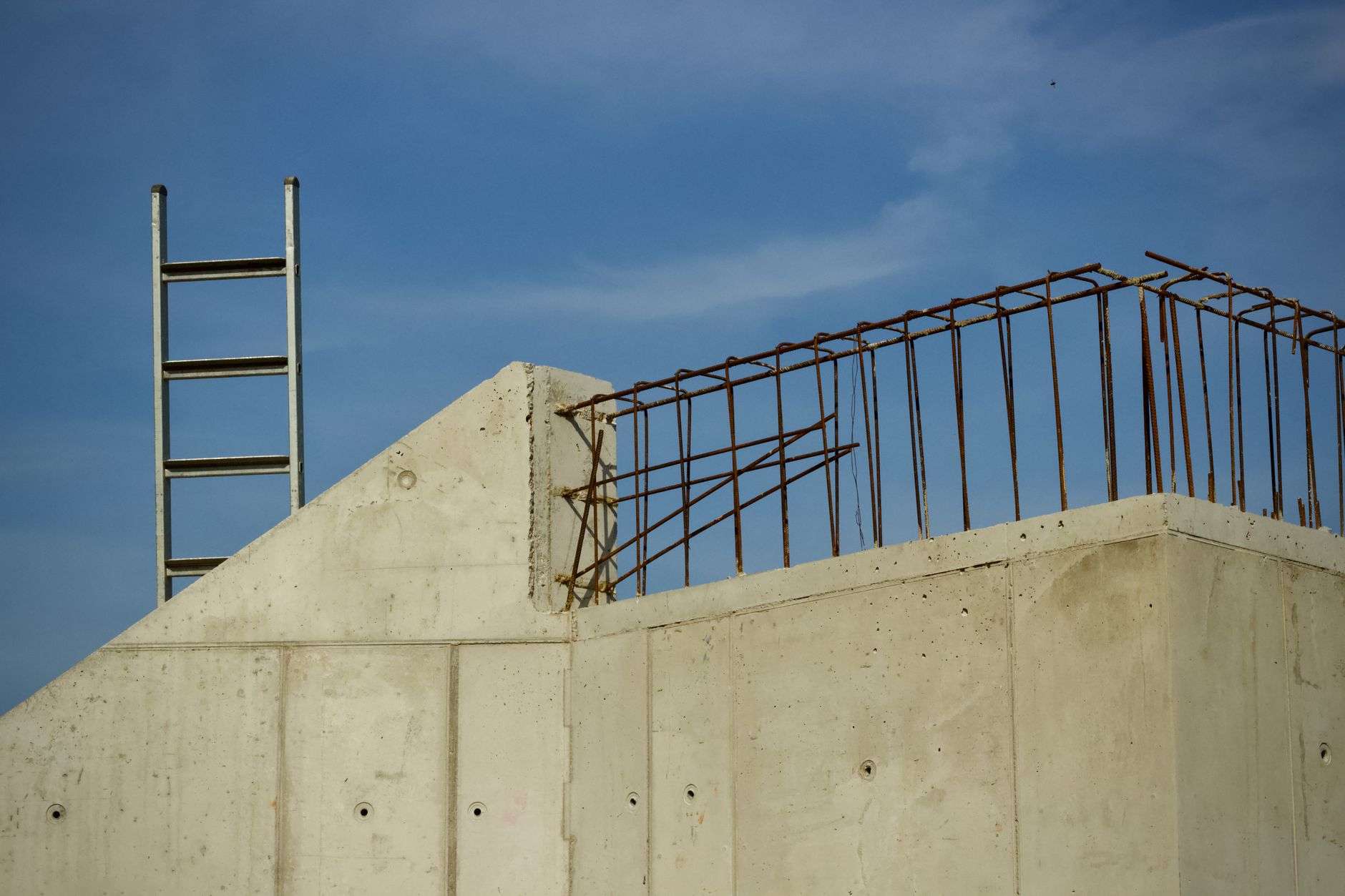
The pour is the point of no return. Everything the structural engineer specified either got built or it did not, and after the truck leaves nobody can tell the difference from the outside. So the last hour before concrete arrives is the most valuable hour on the job.
Bar size and count
We start with the schedule and physically count. Not “it looks like the drawing” — count the main bars in each face and check the diameter with a gauge or callipers. Y12 and Y16 are easy to confuse on a busy cage, and a column short of two Y16s in the tension face is a real reduction in capacity, not a paperwork issue.
Substitution is the other thing to watch. If the yard sent Y12 where Y16 was scheduled, someone on site may have “made it up” by adding bars. Equivalent area is not equivalent behaviour — bar spacing, bond and crack control all change. Substitutions go back to the engineer, not to the foreman.
Links and stirrups
This is where we find the most problems. Links do three jobs: they resist shear, they restrain the main bars from buckling, and they confine the concrete core. All three depend on spacing and on the hooks.
- Spacing. Measure it, particularly near the ends of beams and at the top and bottom of columns where the schedule usually calls for closer spacing. Gangs working quickly tend to space uniformly because it is faster.
- Hooks. Links need proper 135° hooks with an adequate extension, turned into the core. Ninety-degree hooks straighten out under load and the link stops confining anything.
- Closure. Every link fully closed and tied. Open links do nothing useful.
Laps and anchorage
Lap lengths come off the schedule and depend on bar diameter, concrete grade and whether the bar is in tension or compression. We check the length with a tape, and we check the positions — laps belong where stress is low, and staggered, not all at the same level. A row of laps at one section is a plane of weakness.
At beam-column junctions we check that the beam bottom bars are properly anchored into the column and that the top bars continue over the support. Reinforcement drawn continuous on paper and cut short on site is one of the most common serious defects we find on projects we are brought in to review.
Cover and cage position
Cover blocks on every face at roughly 800mm centres, of the correct thickness for the element. We also check the cage is central where it should be, and that starter bars for the next lift are in the right position and long enough — a starter bar 200mm short means either an unplanned coupler or a lap that does not comply.
The last two checks
Formwork. Clean, oiled, properly braced and tight at the joints. Grout loss through an open joint leaves honeycombing exactly where the section is smallest.
Access for the pour. Can the poker actually reach the bottom of the section? On heavily reinforced columns the answer is sometimes no, and that needs to be solved before the concrete arrives, not during.
Record it
Every pour on our sites has a pre-pour inspection sheet, signed, with photographs of the cage from each side before the formwork closes. It takes fifteen minutes. It has settled more disputes than any other document we keep.
OK Estate Construction and Supply Limited carries out reinforced concrete works and site supervision across Uganda and South Sudan. Talk to our team.